Showing posts with label nostalgia. Show all posts

10.2.11

Who really lived in my house?

1877 map of Preston Circus: Gerard Street is off Clyde Road

When I wrote about who lived in my house, I didn't actually know who was a landlord and owned my house, and who was a tenant and actually lived here. Looking at census records however (thanks to David Pipes for supplying them as it is sometimes difficult to search on an address rather than name), it became clear that names were popping up that I hadn't heard of before. Henry Burnham was the only chap mentioned in the mortgages. One thing that struck me was how many people there were living here sometimes: two families in 1881, plus a mother-in-law and lots of lodgers and boarders too. It was exciting to discover that an engine driver once lived under this roof, even though he lied about his age!

Page's Directory 1877 - no mention of Gerard Street
Page's Directory 1879 - 'small houses'

1881 Census
Fanny Eager, 29, laundress
Alice E, 10, scholar
William R, 7, scholar
Geo C, 5
+
William Christmas, 33, lab(ourer?) from Guildford
Mary, wife, 28
John, 3
Wllm H, 1
(+ a Miss Sayers who didn't sleep there!)

Page's directory 1889 - Mrs Fanny Eager, laundress

1891 Census
Henry Burnham, 55, night porter - hotel
Louise, 45, wife
Henry, 6, son
Ada Louise, 12
Henrietta Elizabeth, 9
James Fielder, 21, lodger, firefighter
William Rapley, 19, lodger, engine cleaner

Page's Directory1892 - Mrs Burnham, dressmaker
Page's Directory1894 - Mr W Hale
Kelly's Directory1898 - Willian Thomas Hale
Pike's Directory1900 - Walter Simfield
Towner's Directory 1901 - Mrs Martyn

1901 Census
Harry H Hollist, 51, engine driver (locomotive)
Mary A, 49, wife
Eliza S Martyn, 72, mother-in-law

1911 Census
Harry Harding Hollist, 46, engine driver
Mary Ann, 45, wife
Henry Horace Martyn, 6, adopted son
George Robert Rutter, 21 , boarder, coachmaker
Walter Stephenson, 22, boarder, carr.(iage?) finisher

[Hmmm, was someone lying about their age?]

Kelly's Directory 1949 - Henry Harding Hollist
Kelly's Directory 1954 - no entry
Kelly's Directory 1955 - Mrs Bunney
Kelly's Directory 1958 - Alfd D Greene
Kelly's Directory 1974 - ditto [last directory in local history library]

1.2.11

Who lived in my house?


A while ago I asked my building society for a copy of my house deeds. I was wanting to find out when it was built. They said there would be a charge, but that they had a whole lot of other stuff I could have for free. I said yes please and a few days later a huge Jiffy bag full of ancient documents arrived. It was every single mortgage that applied to this address. It's now in a safe at my solicitor's but I took some notes first.

The land was once owned by the toffs who lived at Preston Manor, the Stanfords. It was fields of sheep with the odd windmill. Then the railway viaduct was built in 1846. Amongst the documents was an act of parliament that was all about a Stanford hieress, who to inherit the pile had to get any husband to change his name to Stanford. It may well have been Lady Ellen Thomas-Stanford, who eventually left the Manor to Brighton council.

On 3 June 1878, a Joshua Yardley (Yardley Street is the next street up the hill) sold a parcel of land comprising Nos 18 and 20 to Sidcup builder Josiah Roome for £180. I don't know if he bought any other plots.

Elizabeth Dipple took out a £400 mortgage on the property on 6 July 1878, but on 2 October innkeeper Charles Delmon bought the house from J Roome for £320. It's not clear when the house was actually built! On 24 June 1890, Henry Burnham - an army pensioner and hotel porter of 24 Gerard Street, bought it and on 19 December 1892 William Thomas Hale, a police detective, bought the house for £250. So much for inflation! On 17 October 1893 a jeweller called Robert Morse Younger took it off his hands. Another jeweller called James Henry Wellings paid £300 for it 5 June 1906. He lived here a while, because it wasn't until 9 November 1936 that Lily Hewetson, a clerk, bought it for £475 from Ernest Albert Hopkins and Geo Herbert Fowler. Who are they, you might ask? Possibly the people handling probate? Lily died 15 January 1939.

On 18 March 1939, James Wllm Hopkins and Elizabeth Mayo Hopkins paid £500 to vendor Simpson Hewetson for my house. We then leap to 20 April 1953 when J W Hopkins sold it on to Iris Goldsmith. A couple of months later and on 5 August 1953 Mrs Goldsmith sold it to Winifred Bunney. On 24 December 1968 it was owned (or rented?) by the delightfully named Aileen Beatrice Henville Chappell and Gwendoline Maud Henville de Graaff-Hunter. Sisters perhaps? 9 May 1974 it was acquired by Alfred Douglas Greene, the administrator of Win Bunney and, by 9 November 1977, Paul Nigel Abraham and Pamela Anne were living here. On 29 May 1980 it was bought by Raymond Barry Bisson and Elizabeth Ann Bisson for £9,950. When I viewed the house Liz was living with Dave Wilshire, the signwriter. They both now live in Australia. Liz's previous partner became a Buddhist monk and presided over a funeral I attended at the Crem. I moved in May 1987, and the rest they say is history!

One day, I'll try to fill in some details from census records and Kelly's Directory information but that's enough for now.

20.1.11

My life in a map


You may have noticed I haven't been moaning much recently. Well I certainly have reason to - about my bloomin' Epson R2400 printer which has finally gone to the menders, and the fact that the Brighton recycling lorry came a day early, despite the council sending out a calendar of dates, followed by a revised calendar cos the first one had a wrong date on it - but I haven't been blogging them! Instead I've been messing around with Google Maps and managed to put every place I've ever lived onto a map. I've lived in 23 different houses, bedsits, rooms and flats, some for as little as three weeks. This morning I added all the places I've ever worked. So my whole life to date is on one map. Some places have been demolished; others are approximately located as it's sometimes difficult to read house numbers on Street View, and my memory isn't that good. My Maps is great - I could imagine using it as some kind of immersive narrative device, for eStories. Maybe I'll think about that. If that 'View ... in a larger map' link below doesn't work, try this link.


View Larger Map

3.1.11

Kibbutz Ga'ash


Fred in Israel
Originally uploaded by fred pipes
Talking to an Israeli dancer last night at Foz? and Max's party I was reminded of the time I spent in Israel - April-June 1970. I can't find any diary entries for it (there's a gap in my journals from 1970-72!) so this is from memory. My adventurous girlfriend at the time Maddy said she was going and did I want to come? Err, yes, I replied. I was working in a dead-end job, in the dark mostly at Taylor's photo lab in Rodboro Buildings, Guildford, and sharing a room with Gus at 7 Mill Lane, so I thought why not. The plan was to fly to Tel Aviv on a one-way ticket, stay for an indeterminate time, then somehow hitch home via Greece!

The flight cost about 34 quid. We stopped to refuel at Istanbul and arrived at Tel Aviv early in the morning. After much traipsing round the suburbs we found an agency and were sent to Kibbutz Ga'ash, near Netaniya, on the coast. We were put into the wooden huts previously occupied by the settlers, who'd moved on to brick-built bungalows. It was all very informal - our jobs for the day were posted up outside the post office and we ate with the other volunteers in the communal dining room. Contact with the kibbutzniks was minimal. My main job was in a small factory making sheet metal fluorescent light fittings; Mad mainly looked after the chickens. Every so often we had to join in the harvest, potato picking for example, which was relentless back-breaking work - you had to gather the tractor-exposed spuds in buckets before they were covered over by the next furrow! The factory was more cushy, with regular coffee breaks! We were paid at the Post Office - a few Israeli pounds, 100 Nadiv untipped cigarettes a week (with tobacco so dry that if you tapped a ciggy it would all fall out), a small tin of coffee, and toothpaste if we needed it. We could take what clothes we needed from the laundry. Every blue moon there'd be a film show in the dining room, or the next kibbutz and if you were lucky you'd get a lift in a tractor.

We were close to a lovely unspoilt beach, under cliffs, and as it got too hot in the afternoons to work, we spent some time there. There were barbecues that involved killing chickens! We also went on several excursions - the Kibbutz was very relaxed about us going off on jaunts, mainly I think because the settlers were from South America with a maƱana attitude. Hitching was easy and common, although any soldiers waiting in lay-bys got priority lifts. We went to Jerusalem (making a point of visiting the Garden of Gethsemane on the advice of an Al Stewart song), Nazareth, Bethlehem, and Hebron (a lift in an army half-track), north to Caesaria (where the beach was littered with Roman tesserae), Haifa, Tiberias and the Sea of Galilee, south across the Negev desert to the hell-hole (then) of Eilat, the hottest place I've ever experienced. We slept on the beach, where mad locals would drive their jeeps all night. The coolest place to be was in the Red Sea. We couldn't get out of there because it was a long national holiday! We stayed mainly in segregated youth hostels or cheap hotels. The only place we didn't get to see was the Dead Sea.

It was at Ga'ash that I heard (from the man in the post office) that the Beatles had split up and that Johnny Hodges had died. It was a great place to hide away - in fact I'm sure one of the volunteers was an international criminal cat burgler - a big black car would arrive and whisk him off to Tel Aviv night spots. The food was good, although there was not much in the way of booze. The Shabbat wine was weak, sweet and full of flies - we used tea strainers to filter them out. But there were always plenty of oranges. After a while we wanted to get home, but had no money. We needed dollars to buy air tickets. I wrote to Gus for him to send some cash in an envelope but he did something through a bank and that came to nothing. Maddy rather foolishly sold some blood! We'd gone off the hitching through Europe idea. In the end, a new volunteer from the USA kindly cashed our Israeli money into hard currency and we got home. Back at Gatwick we were surprised to be able to change our remaining Israeli cash into proper money, and got the train back to Guildford.

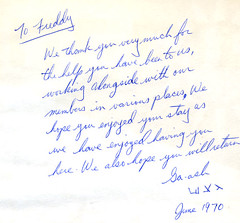
On leaving the kibbutz we were each given a book (by the man at the post office) with a sweet inscription, as shown below.

Inscription

31.12.10

Poppa Ben Hook


Poppa Ben Hook
Originally uploaded by fred pipes
When Helix split up in 1969, I got more involved with Guildford Arts Lab (reading poems at Boxer's coffee bar for example) and thought I'd try to get some gigs for the Arts Lab 'house band' Poppa Ben Hook using my contacts. It was on a visit to Pete Jenner at Blackhill and impressario promoter Stuart Lyon to drum up trade that someone suggested I manage them! Management seemed to involve storing all their gear in the bedroom of my first-floor flat on Epsom Road. I also sent out demo records to record companies and management agencies, with no success. Loving nothing more than doing a bit of Letraset, I produced a leaflet that was an exact rip-off of one Rick Welton had done for his Hull band Nothingeverhappens.

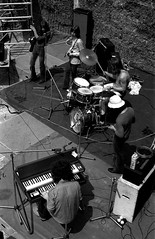
We did do lots of gigs however and I went along to all of them in the van. We very nearly played at the very first Glastonbury Fayre in 1971. I'd written to Arabella Churchill offering our services and she said to come along. We'd been booked to play a free festival at a place called Holcombe Rogus in Somerset, where Nick Black, a school friend of David Ambrose, had set up a commune, making pottery and generally spending his money.

glasto
The letter!

On the way back we called in at Glastonbury, I waved the letter and we went to the farmhouse. It was a bit chaotic as you can imagine and we were told to wait. Everyone was knackered - Bob in particular had spent all the previous night fighting off a randy hippie mother - and the concensus was to head for home. The rest is history. We also played the various University of Surrey Free Festivals (see the photos from 1971).

The line up was Bob Thomas on organ, electric piano and vocals, Roy MacGregor on guitar and vocals, Max Thomas on flute and alto sax, Phil Plant on bass, and Alan Butcher on drums. Bob did amazing things with the keyboards, slowing a Watkins Copicat tape to psychedelic effect. Tragically, Bob died young. Phil Plant went on to play with Stomu Yamashta and in 1976 played bass guitar on the soundtrack to 'The Man Who Fell To Earth' starring David Bowie. He's currently with Roxi and the Blue Cats. Al Butcher is also still playing - with Flying Visit. I'd like to think that Max is playing jazz somewhere.

Drum skin, as painted by Bob Thomas, Courtesy of Al Butcher
They were a great band and should have done better things. Here are some demos on acetate:

Buzz

Buggy run

I live in a shed

Pure beef hamburger

Before the dawn

You won't miss me (vocals by Roy MacGregor)

Well, it took 45 years, but I finally got a record deal for  Poppa Ben Hook. It's a shared vinyl release from Record Collector with a band called Museum, who sounds rather like PBH, so is a good match. I'm still trying to track down Max Thomas and Roy MacGregor. It was released 2 January 2015 and costs £24.98 in the UK.

22.11.10

Vintage bus day at the Bluebell

Two or three times a year, vintage bus owners give rides to the Bluebell Railway and back in their beautifully restored vehicles - for free. These events usually coincide with special events, but unfortunately the Bluebell's 'Giants of Steam' gala coincided with the East Lancs Railway's Autumn Steam event so I was unable to go to that one. Sunday however was billed as Vintage Bus Day and so after a quick whizz round the Art Junkie at the Phoenix gallery, I crossed to St Peter's and flagged down a Stratford Blue Leyland Leopard HAC 628D and sank back into the plush deep blue unholstery for a pleasant ride to Sheffield Park, via Lewes.

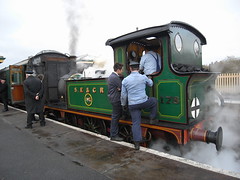
At the station there was a splendid array of Southdown buses in the car park (one of which I was to take back to Brighton). It was time for the 1pm train so I jumped into one of only two carriages being hauled by Wainwright P Class 0-6-0T No. 178 in the green livery of the South Eastern and Chatham Railway. We had to wait for the 'Golden Arrow' dining train to come in, hauled by London, Brighton and South Coast Railway 0-6-2T No. 473 (formerly known as Birch Grove), so we left about 20 minutes late. At Horsted Keynes I spotted Standard BR Class 4 2-6-4T No. 80151 coming the other way - the only other loco in service.

So it was to the end of the line at Kingscote, and back. Because there were only two coaches it was as crowded as a rush-hour tube train, with the added delight of several hundred screeching babies brought on the pretense of perhaps seeing Thomas The Tank Engine and the Fat Controller I can only suppose! But it was a lovely journey nevertheless, with the spectacle of lots of fat pheasants struggling to fly away from the cutting verges - and I think I saw a deer. Although it was fine it was not a great day for photography, nor for hanging about on platforms. Back at Sheffield Park, it was getting dark and there was a huge queue for the buffet so I had a quick look in the sheds and home (on Southdown No.547 PUF 647, a Park Royal-bodied Guy Arab from the 1950s) in time for a second look round Art Junkie!

Previous visits to the Bluebell:

4.10.10

Internet veteran? moi?

Just been going through some old files, to try and find camera invoices, when I came across one for my first modem. I bought a US Robotics Sportster 14k (the Stylophone) from Dabs Direct for £129 on 4 August 1994. Can anyone beat that? I also have bills from my first ISP: Soft Solution (MCR1 Manchester Host) of Dewsbury - NUJ Net special offer £12 subs for three months - my charges for August 1994 totalled £46.23. NUJNet (Sam called it nudge-net) was set up by Mike Holderness and was text-only - and you had to dial in to Manchester. I mainly joined because Sam was at college and was keeping in touch with all his school chums by email. And I thought, if you can't beat them, join them! I also joined some dial-up bulletin boards. Soon after I got online, Pavilion started up in Brighton and I joined them - and started to see graphics in my browser.

My first computer in Brighton was a Mac Plus and I remember you had to buy a particular book to get the floppy disc with the right software on it to get connected. Simon Thornton also helped me out. At the time there were only about five people in Brighton on the net. The Brighton internet pioneers met at the Greys to chat: Tom Hadfield (of Soccernet fame) was about 12 and Tom Shepherd was only 16, so we had to sit outside! Other trailblazers included Matt Planet and Simon and Neil Turner of Virtual Brighton who very kindly gave me a brighton.co.uk address. Later, Mistral started up and they were cheaper, so I switched. Then Freeserve started up and that was free, so I jumped ship again. These were all dial-up services. I subscribed to the always connected ISDN Home Highway with BT for a while, but when Broadband arrived there was no upgrade path so I told BT to go away and went cable broadband with Virgin.

Before all this, whilst working at EMAP, I had on loan a Spectrum set-up with an acoustic coupler that connected to something called MicroNet, a Teletext/Prestel type service. After experiencing that I never imagined that the internet would take off as it did.

3.10.10

My cameras


Me and Benji in Sunny Bank
Originally uploaded by fred pipes
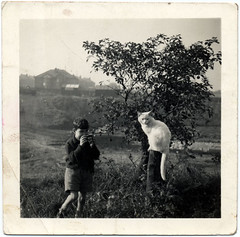
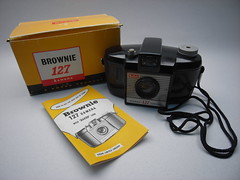
It's that photo again! It was such a find amongst my Dad's old things and proves I was into photography at a young age. Not sure if that Kodak Brownie 127 was really mine, though. Cameras have always been a big part of my life, though I've never been geeky about them - just wanted them to do the job. The first real camera I owned was a metal Boots camera, that looked like a camera ought to, though it had few controls. It must have taken 127 film, though it looked like a 35mm one. I used to take it with me trainspotting and I'd love to see those negatives now, but alas they have gone.
Kodak Brownie 127
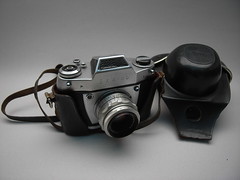
When I went to college in 1965 I bought an Exa IIb 35mm camera and a separate light meter. I think I was copying my friend Jorj Malinowski, who had a more up-market Exakta. It was a single-lens reflex made in Dresden, with an instant-return mirror and served me well for many years. It had a Tessar 50mm f2.8 lens. I used to develop and print my own photos, but the fashion then was for high-contrast (blame David Bailey), so most of my negs are pretty useless now. I also had movie cameras: first a Bell and Howell Standard 8mm with zoom lens, later a Standard 8 Russian Quarz camera with loads of accessories, that looked more like a Bolex.
Exa IIb
In the mid-1970s, when I was better off, I bought a Pentax MX, mainly because it was so compact, with a stubby 40mm f2.8 lens. It had been a toss-up between this and an Olympus OM-1, but I prefered the Pentax's traffic-light metering (just set the speed and twiddle the aperture until it shows green for go) over the Olympus's needle meter. It was totally manual; the battery only controlled the light meter. I also bought a 135mm lens for portrait work.
Pentax MX
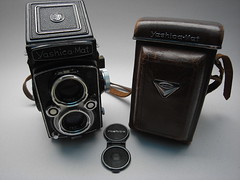
Around this time I bought a whole load of darkroom equipment and a Yashica-Mat 120 camera from a friend at work, whose dad was selling up. I think I paid £25 for it. I didn't take many 2 1/4 x 2 1/4 photos with it as you only got 12 per film, but what I did take were of superb quality.
Yashica-Mat
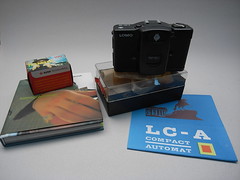
I was introduced to the Lomo LC-A in 1998 by Simon Williams, who I was working with at Time Team. In those days you had to buy them off the Lomo Ambassador in London and needed a personal recommendation! You also had to make a pledge to carry them about with you at all times! It's a 35mm camera with a plastic lens that somehow makes everything you snap more garish, especially at night using automatic exposure.
Lomo
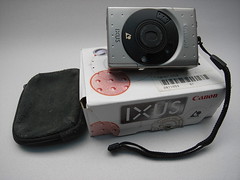
My Pentax and accessories - flash unit, other lens - was too much to cart around everywhere, so in 1998, I bought a Canon Ixus APS camera. These were tiny - the film was smaller than 35mm and came in an automatically loading cassette. One feature was that you could set it to take panoramic views, tho I soon twigged that all it did was crop the regular shape. This got stolen in 2005 from my cycle bag and I replaced it with a similar model bought off eBay for £10! But I never ever used it - when I saw the price of film I decided to go... digital!
Canon Ixus APS
More to follow...

24.9.10

Barbed Wire part 1

Issue 0
[Continuing my musical reminiscences...]

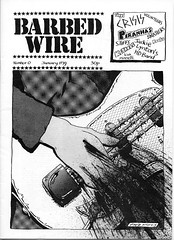
Fast forward to the end of the 1970s: I'd been married and was now single again - and desperately needed a project! On a visit to Exeter to see my friends Steve (on the Flying Post) and Wendy and Dave and Jude I came across a couple of fanzines - Dat Sun and Worthless Words - and wondered why Guildford didn't have one like them. There were plenty of bands to write about, and I was certain there were lots of people eager to write about them. The post-punk scene was thriving, with pubs like the Wooden Bridge, Royal and Star putting on gigs regularly, but the only outlet for them was the Surrey Advertiser and its Go-Ahead Generation page in the Wednesday edition.

So, I rallied my musical chums and put the idea to them. Gus Garside came up with the name and I drew the cover of issue one, dateline December 1978/ January 1979 (or Number 0 as it was called, in Crumb's Zap comic style!). Other contributers included KT Ekberg, who worked at the Surrey Ad, Dave Ambrose, 'Mustang' Sally Clark, the mysterious Virginia (who revealed herself recently as FaceBook friend Virginia Black Nearerdark), and Sara Elliot at work (IPC Science and Technology Press where I was Deputy Editor of Energy Manager) who typed it all out. The first one even included a pub guide by 'Egon Rooney' (Clive Young), but the most valuable content in retrospect was the forthcoming gigs list on the back page, which told the readers that Brighton band The Piranhas were playing the Royal every Friday night, and that The Vapors were playing at Scratchers (The Three Lions in Farncombe) on Sunday 14 January. It ran to 16 pages and was printed by Sprint - one of the criticisms it got from other, photocopied, fanzines was that it looked too professional!

It sold for 30p in record shops such as Bonapartes in Phoenix Court and also carried a few ads. I took most of the photos and did a bit of artwork here and there. Not many sold! First article, on p3, was on Who Invited Them? by Ian Walker, starring Sev Lewkowicz (now resident in Brighton). Other articles featured The Piranhas (Katie Ekberg), Crisis (Virginia), The Volunteers (Sally Clark) and Liza Minnelli (Katie Ekberg)!! Plus gig write-ups (including the Be Stiff Route 78 tour, the one with Wreckless Eric), record reviews by all and sundry and a gossip column called 'Notes on Notes' mostly written by Gus.

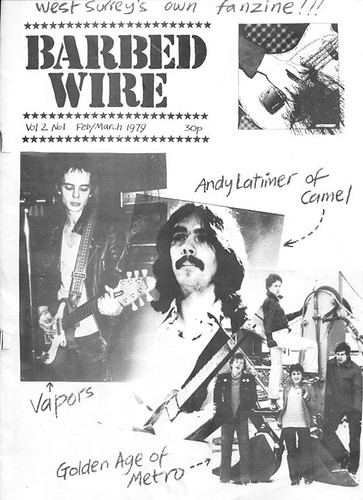
The second issue (Vol 2 No 1) came out Feb/March 1979 and was printed in an architects' office (SBT) after hours by Sharon Whittaker, who also shared Nick's flat where I was living, and her boss Mrs Hook: I pasted up the typewritten text onto boards using Cow gum and put squares of black paper where the photos would be - any other embellishments were drawn in ink directly onto the camera-ready copy. In return I was given the pages as negative film and stripped the half-tones into the clear holes made by black squares of paper using sellotape. The printed sheets were later folded with the back of a spoon, collated and stapled by mostly me on the floor of my flat on York Road. On the cover were The Vapors, Andy Latimer of Camel and the Golden Age of Metro. I remember first seeing the Vapors at the Royal after abandoning a gig at the Wooden Bridge. It was love at first hearing: Alan 'Bed and Breakfast Man' Neve was dancing at the front and they just blew me away - I've been a big fan ever since. Gus had the main feature - on Camel, Virginia wrote about Metro, centre spread was on Rubber Flowers by NW (?) and there was a review of Brighton classic album Vaultage 78 by Ellen Jones. And Sev got his own column.

Barbed Wire ran to six issues, the last one in May/June 1980. It never sold well - most got nicked - and we were eternally grateful to Rough Trade for taking 50 copies cash in hand, and we sold the odd ad to record shops, barbers and sound studios. One great spin-off was getting into gigs for free on the guest list - and free records, tho they generally got kept by the reviewers. More later...

bw2.jpg


More photos on Flickr.

22.9.10

Helix: my time as a rock star

[This recollection was first published on my Geocities website in 2006 - but as the future of Geocities is uncertain, I thought I'd re-publish it here with a few tiny amendments.]


I did promise, on my British Blues page, a history of Helix, the poetry and jazz band (don't laugh!), starring Yours Truly on harmonica and poems, Rick Welton, also on poems, Chris Brunt on flute, alto sax, clarinet and guitar, Peter Panayi on bass (there's a recent picture of him in the News section of www.brookguitars.com), Peter Jackson on guitar and Terry Raven on drums. I was off to a Physics Dept reunion at the University of Surrey, and rooting through some ephemera, when I found a cutting of an ad in NME (or was it Melody Maker?) showing us supporting Joe Cocker on 24 January 1969, our greatest achievement!


It all started in the folk club at UoS (then Battersea College of Advanced Technology) where me and Chris did a double act: he (Blind Willie Brunt?) on guitar and me (Whistlin' Walshaw Fred) on harmonica, singing the blues. Also playing regularly were duo Pete Panayi and Ronnie Hicks (wife of Rick Welton). Eventually we all got together to perform Dylan songs with Ronnie as vocalist. Rick was the roadie (he had a van) but started adding his poetry to the mix. Then Ronnie left and we decided to go electric. An ad in NME (or was it Melody Maker?) produced Peter Jackson, who'd been playing the US bases in Germany, and part-time Horror film actor Terry Raven. By now we were doing poems (me funny, Rick serious) and the odd Mose Allison song (plus 'Scarborough Fair' I think!). There is one recording, made at All Saints Hall in Powis Square, Notting Hill, recorded by Ronnie's new bloke, film sound man Tony Jackson, but we never made any records.


We were represented by Pete Jenner of the Blackhill agency (who managed Pink Floyd before Syd left, and went on to organise the Hyde Park free concerts) - Lynne, a booker there was married to my friend Adrian Boot, who went on to photograph Bob Marley and others. Their offices in Notting Hill later also became home to Stiff Records. We did gigs at Canterbury (supporting Third Ear Band), Bradford (with Liverpool Scene), Chelsea Town Hall, Bridgend in south Wales, in Battersea's Courland Grove halls of residence where I met an American girl called Clare Greenwood, and in Guildford, at the Stoke Hotel (22 December 1968) where I met Jenny Parsons and was introduced to Guildford Arts Lab. 


Two notable concerts were the Jazz Poetry Song Package at Battersea Town Hall on 28 November 1968 and Guildford Civic Hall on 8 December, both with the Michael Garrick Quintet featuring Don Rendell and Ian Carr with various poets, including Jeremy Robson and Vernon Scannell, with Ron Geesin and Pete Brown (of Cream lyrics fame) and his Battered Ornaments (inc Chris Spedding and Dick Heckstall-Smith).

All done in Letraset by Rick!

The Stoke Hotel gig may have been our last. Rick moved to Guildford to run the first Guildford Festival (he's now a LibDem councillor in Hull), and I followed some time later. Chris teamed up with Ronnie and Eric Johns (brother of Dorris Henderson) to form Gallerie, who played with Roy Harper and Michael Chapman in the 1971 Guildford Festival, the one I directed. By now I was reading poetry with the Arts Lab and about to get married. To be continued dot dot dot

Page from the programme of Jazz Poetry Song Package (price 2 shillings) 
Other reminiscences:
Prologue
British Blues: part 1 Bury
British Blues: part 2 Manchester
British Blues: part 3 London

Glad Day and Guildford Arts Lab

Jump to the post-1969 Arts Lab years of Shyneford >>

16.9.10

Can blue men sing the whites? Part 1 Bury

[This recollection was first published on my Geocities website in 2006 - but as the future of Geocities is uncertain, I thought I'd re-publish it here with a few tiny amendments.]

Every harmonica player wanted to play 'Country line special' like Cyril! Recorded 1963; Cyril died in 1964

I just watched Mike Figgis's contribution Red, white and blues (what on earth were Tom Jones and Lulu doing in there?) to Martin Scorsese's The Blues and thought I'd add my recollections to the debate.

I was born and brought up in the northern town of Bury, Lancs (now part of Greater Manchester). My earliest memories of pop music were hearing The Shadows play Apache on a tannoy at Tranmere Rovers football ground (Bury beat them 7-1!), and Del Shannon, Dion and Johnny and the Hurricanes while watching the girls on the waltzers at Bury fair. My dad played double bass in a dance band at Alma Lodge and had a few jazz records‚ light stuff mainly, like Oscar Peterson. He got talked into playing with a rock'n'roll singer once (I went to a rehearsal) but he thought it was rubbish and never went again. My first LP was a 10-inch 'The Duke wore jeans' by Tommy Steel; my first single was Tom Dooley by The Kingston Trio (not the Lonnie Donegan cover!). The first concert I attended was Adam Faith at the Royal cinema (14 November 1960). It was more like a variety show, with the John Barry Seven and other acts.
Found this poster on the Bury Olden Days
Facebook page
Me and my friend Roy Henshall used to listen to Radio Luxemburg – he'd tape all the distant sounds on his reel-to-reel. I remember hearing 'Love me do' for the first time and thought Wow! this band will go far! We eventually formed a band, with Michael Brawn on drum (yes, he only had a snare!), called The Roadsweepers. Later Roy learnt some chords and ended up with Billy J Kramer and the Dakotas (after they were famous). He's now living in Tenerife.

I also bought Volume 2. These were recorded in 1962 and featured Alexis Korner on guitar and Keith Scott on piano
There weren't any blues records to buy in Bury. I read a rave review of Alexis Korner's R&B from the Marquee (1962) and ordered it from Boots on the Rock ( I later lent it to John 'Faff' White in Guildford and never got it back!). In other record shops I also found a couple of EPs with Alexis Korner on guitar called 'Chris Barber presents Jimmy Cotton' in the jazz section, and an LP called 'Murderers' Home' on Golden Guinea – recordings of prisoners' work songs by Alan Lomax.

'Early in the morning' was covered by Alexis Korner and Graham Bond amongst others 
Eventually I found the classic blues EP 'The sound of Cyril Davies' with the amazing 'Country line special' – there's no line-up listed on the sleeve. I bought Alexis Korner's Blues Incorporated at the Cavern and also found an old Alexis Korner Skiffle Group EP in a bargain bin, called Blues From The Roundhouse Volume 1 (I found out later that there was also a volume 2!) also starring Cyril Davies.

Recorded 1957 and featuring Cyril Davies on 12-string guitar and harmonica and Mike Collins on washboard!

Other reminiscences:
Prologue
British Blues: part 2 Manchester
British Blues: part 3 London
Helix
Glad Day and Guildford Arts Lab

15.9.10

I'm from Bury


me-and-benji72.jpg
Originally uploaded by fred pipes
...sings Mark E Smith, even though he's from Prestwich, closer to Manchester. I'm from Bury, Lancs - or now Greater Manchester - in the North of England. I was born two years after World War II ended in a maternity hospital in a district called Jericho and lived for my first three years in Wyndham Street, in an area of central Bury called The Mosses. After that we went up in the world and moved nearer Whitefield (and Prestwich) to an estate of semis called Sunny Bank, when it was just three or four streets off Manchester Road, surrounded by fields. The fields were being built on - so lots of places to play, including lime pits - and today it's a huge sprawling suburb, a mainly Jewish overspill from North Manchester. Dad, being a travelling salesman for a paper-machinery company, had the only car, well, a green Commer van actually, in the street for many years. We weren't the first to get a television, however.

The Mosses was demolished and lay empty for years, the grid of streets still visible, hosting the annual fair, with its black pea stalls, nude show, steam yachts, big wheel and waltzers, which as kids were our discos, playing all the hits - Johnny and the Hurricanes, Del Shannon and Lord Rockingham's XI - at full volume, trying to mask out the noise of the huge throbbing generators ringing the fair's edges. Today it's buried under the 'world-famous' market and Angouleme Way (named after Bury's twin town in France).

School was a long walk away back in the direction of Bury: St Chad's near Gigg Lane, home of Bury FC 'The Shakers', and then after my 11+ Bury High School, which became The Derby School, and is now a sixth-form college. I failed to pass the entrance exam into Bury Grammar School so never met Victoria Wood! The other place to hear pop music was at football matches and I can remember first hearing The Shadows' Apache at Tranmere Rovers' ground, when Bury thrashed them 7-1 (on 1 October 1960).

Another place I lived for about a year 1961-62 was The Robert Jones & Agnes Hunt Hospital in Oswestry, Salop, where I was 'cured' of a congenital defect - well, they tried their best. Treatment for the condition is much more successful nowadays. Soon after returning home, we moved to the other side of Bury, off Bolton Road, to a dormer bungalow. It was still a long walk to school! My sister and her children all live nearby to this day. In 1965 I travelled south, to London (along with pop star Peter Skellern), a place Down South I'd read about in Melody Maker, the NME and Sounds - where it was all happening.

The reason I'm writing this is to preface some reminiscences that I'm going to move over from my Geocities site to this blog, as Geocities will be closed down at some point.

Other reminiscences:
British Blues: part 1 Bury
British Blues: part 2 Manchester
British Blues: part 3 London
Helix
Glad Day and Guildford Arts Lab

10.11.09

Bury mods


John Dicky and Vanessa
Originally uploaded by fred pipes
When I was up in Bury last week, I was reading the Bury Times when I spotted a letter from Vanessa Major, wondering about the whereabouts of John Dickie, who she knew in 1967. This prompted me to dig out some old photos from that time - I wish I'd taken more of them. I was at college in Battersea 1965-68 but visited my home town of Bury in the vacs with my brand new Exa IIB 35mm SLR camera. Unfortunately I developed the photos myself, so the quality isn't great! These images (more on Flickr) were scanned from the negatives. This is the gang that hung out around Melody Fair record shop on the corner of Market Street and Kay Gardens, frequented Bury Palais de Dance at every opportunity, and travelled to Manchester on the electric train each Saturday night to groove to the latest R&B and soul sounds at the Twisted Wheel, Oasis, Cavern, Jigsaw, Jungfrau etc, etc all-nighters. Further recollections can be read here.