29.10.10

East Lancs Railway Autumn Steam Gala 2010


Tornado
Originally uploaded by fred pipes
What a fantastic line-up of big locos for the East Lancs Railway Autumn Steam Gala: 71000 Duke of Gloucester, jub 5690 Leander, micky 45337, Standard 73129 - and guest star 60163 Tornado! I arrived at Bury Bolton Street on Saturday 23 October and bought an £8.20 round ticket just in time to catch the Tornado-hauled 12.05 to Rawtenstall. At Ramsbottom the Duke was coming back the other way. I jumped off when the train returned to Rammy for a wander round, a £1 tub of black peas and a paper. It was wet and drizzly! I caught the double-header of 73129 and Black 5 45337 back to Bury, had a pint of Black Abbott in the Trackside (where there are always nine real ales on at less than £2.60 a pint), and caught the Leander-hauled train to Heywood and back.

Sunday was much sunnier. This time I was determined to catch the awesome double-header of Tornado and the Duke, leaving for Heywood at 13.40, so had a quick walk round town to see the scary new shopping/apartment area cheekily called The Rock, after Bury's one-time main street, now populated by pound and charity shops. At Heywood, Tornado changed ends to lead the double-header (the Duke had been a banker at the back until here) and off we went - all the way to Rawtenstall and all the way back again to Bury (with the Duke at the back again). Had an Eccles cake on the train - they'd run out of sandwiches! Back at Bury I had a pint of Greenfield's Black Five (4% £2.35) and watched the other locos go by then it was back to my nephew's to relax and watch TV!

Nine ales

There's a video of the double-header on Saturday here, and one of Tornado changing ends at Rawtenstall on the Sunday here (listen to the bloke next to me moaning about other people getting in the way of his snapping!).

Previous visits to the ELR:

Magical Moominvalley


Up in my home town of Bury last week for the East Lancs Railway Autumn Steam Gala and to visit relatives, I always make a point of visiting the excellent Art Gallery and Museum to check out the magnificent Turner, the Royal Lancastrian pottery and all the other Victorian treasures. It pleased me too that the Museum downstairs was at last celebrating the town's industrial heritage of cotton, paper and engineering. On my first visit, the main gallery was closed for rehanging - for a major Tove Jansson exhibition - so I popped back in the week to take a proper look.

It's a big exhibition, with three galleries showing Tove Jansson's mainly pen and ink work from early illustrations for the satirical Swedish magazine Gar, though the Moomins, to illustrations for Alice in Wonderland and The Hobbit. One room aims to capture the magic of The Moominvalley of the Tampere Art Museum: dimly lit with pools of dappled light with Moomin boats and islands of stepping-stones.

Author and illustrator Tove Jansson (1914-2001) was born in Helsinki, Finland, the daughter of artist Signe Hammarsten (known as Ham) and sculptor Viktor Jansson. Her mother designed many of Garm's covers with its eponymous dog, and Tove carried on the tradition, and it was in these 1930s illustrations that the philosophical Moomins first appeared. The first Moomin book 'The Moomins and the Great Flood' appeared in 1945, in Swedish, and was not a great success but the following two 'Comet in Moominland' (1946) and 'Finn Family Moomintroll' (1948) made her famous worldwide. She produced eight books in total that have been translated into 34 languages. In 1954, after the second Moomin book had been translated into English, the Evening News, a newspaper for the London area (no longer in business) published a strip called Moomintroll until 1959, when her brother Lars Jansson took over the strip until 1975 (there are no examples of the strips in this exhibition). She also illustrated The Hobbit in 1962 and Alice in Wonderland in 1966, with some of the illustrations coloured with watercolour. The pen and ink drawings in the exhibition are tiny - they must have been drawn same size - and it is a delight to see such lovely work, along with the pencil marks and touches of process white! The exhibition continues until 15 January 2011.

Some more photos on http://brightonillustrators.co.uk/blog/detail/magical_moominvalley/.

Incidentally, the guard who told me off for taking snaps turned out to be the son of an old Mod friend of mine from the 1960s, Steph Minta!

If you fancy it, I got to Manchester from Euston for £7.25 from the Virgin website; and Brighton to London for £2.50 from Southern. Bury is at the end of the Manchester tram line.

Magical Moomin Valley

More info:
www.bury.gov.uk/LeisureAndCulture/MuseumsAndGalleries/GalleryFeatureExhibitions.htm

4.10.10

Internet veteran? moi?

Just been going through some old files, to try and find camera invoices, when I came across one for my first modem. I bought a US Robotics Sportster 14k (the Stylophone) from Dabs Direct for £129 on 4 August 1994. Can anyone beat that? I also have bills from my first ISP: Soft Solution (MCR1 Manchester Host) of Dewsbury - NUJ Net special offer £12 subs for three months - my charges for August 1994 totalled £46.23. NUJNet (Sam called it nudge-net) was set up by Mike Holderness and was text-only - and you had to dial in to Manchester. I mainly joined because Sam was at college and was keeping in touch with all his school chums by email. And I thought, if you can't beat them, join them! I also joined some dial-up bulletin boards. Soon after I got online, Pavilion started up in Brighton and I joined them - and started to see graphics in my browser.

My first computer in Brighton was a Mac Plus and I remember you had to buy a particular book to get the floppy disc with the right software on it to get connected. Simon Thornton also helped me out. At the time there were only about five people in Brighton on the net. The Brighton internet pioneers met at the Greys to chat: Tom Hadfield (of Soccernet fame) was about 12 and Tom Shepherd was only 16, so we had to sit outside! Other trailblazers included Matt Planet and Simon and Neil Turner of Virtual Brighton who very kindly gave me a brighton.co.uk address. Later, Mistral started up and they were cheaper, so I switched. Then Freeserve started up and that was free, so I jumped ship again. These were all dial-up services. I subscribed to the always connected ISDN Home Highway with BT for a while, but when Broadband arrived there was no upgrade path so I told BT to go away and went cable broadband with Virgin.

Before all this, whilst working at EMAP, I had on loan a Spectrum set-up with an acoustic coupler that connected to something called MicroNet, a Teletext/Prestel type service. After experiencing that I never imagined that the internet would take off as it did.

3.10.10

My cameras


Me and Benji in Sunny Bank
Originally uploaded by fred pipes
It's that photo again! It was such a find amongst my Dad's old things and proves I was into photography at a young age. Not sure if that Kodak Brownie 127 was really mine, though. Cameras have always been a big part of my life, though I've never been geeky about them - just wanted them to do the job. The first real camera I owned was a metal Boots camera, that looked like a camera ought to, though it had few controls. It must have taken 127 film, though it looked like a 35mm one. I used to take it with me trainspotting and I'd love to see those negatives now, but alas they have gone.
Kodak Brownie 127
When I went to college in 1965 I bought an Exa IIb 35mm camera and a separate light meter. I think I was copying my friend Jorj Malinowski, who had a more up-market Exakta. It was a single-lens reflex made in Dresden, with an instant-return mirror and served me well for many years. It had a Tessar 50mm f2.8 lens. I used to develop and print my own photos, but the fashion then was for high-contrast (blame David Bailey), so most of my negs are pretty useless now. I also had movie cameras: first a Bell and Howell Standard 8mm with zoom lens, later a Standard 8 Russian Quarz camera with loads of accessories, that looked more like a Bolex.
Exa IIb
In the mid-1970s, when I was better off, I bought a Pentax MX, mainly because it was so compact, with a stubby 40mm f2.8 lens. It had been a toss-up between this and an Olympus OM-1, but I prefered the Pentax's traffic-light metering (just set the speed and twiddle the aperture until it shows green for go) over the Olympus's needle meter. It was totally manual; the battery only controlled the light meter. I also bought a 135mm lens for portrait work.
Pentax MX
Around this time I bought a whole load of darkroom equipment and a Yashica-Mat 120 camera from a friend at work, whose dad was selling up. I think I paid £25 for it. I didn't take many 2 1/4 x 2 1/4 photos with it as you only got 12 per film, but what I did take were of superb quality.
Yashica-Mat
I was introduced to the Lomo LC-A in 1998 by Simon Williams, who I was working with at Time Team. In those days you had to buy them off the Lomo Ambassador in London and needed a personal recommendation! You also had to make a pledge to carry them about with you at all times! It's a 35mm camera with a plastic lens that somehow makes everything you snap more garish, especially at night using automatic exposure.
Lomo
My Pentax and accessories - flash unit, other lens - was too much to cart around everywhere, so in 1998, I bought a Canon Ixus APS camera. These were tiny - the film was smaller than 35mm and came in an automatically loading cassette. One feature was that you could set it to take panoramic views, tho I soon twigged that all it did was crop the regular shape. This got stolen in 2005 from my cycle bag and I replaced it with a similar model bought off eBay for £10! But I never ever used it - when I saw the price of film I decided to go... digital!
Canon Ixus APS
More to follow...

24.9.10

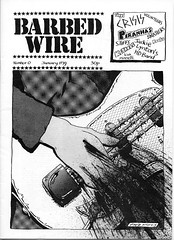
Barbed Wire part 1

Issue 0
[Continuing my musical reminiscences...]

Fast forward to the end of the 1970s: I'd been married and was now single again - and desperately needed a project! On a visit to Exeter to see my friends Steve (on the Flying Post) and Wendy and Dave and Jude I came across a couple of fanzines - Dat Sun and Worthless Words - and wondered why Guildford didn't have one like them. There were plenty of bands to write about, and I was certain there were lots of people eager to write about them. The post-punk scene was thriving, with pubs like the Wooden Bridge, Royal and Star putting on gigs regularly, but the only outlet for them was the Surrey Advertiser and its Go-Ahead Generation page in the Wednesday edition.

So, I rallied my musical chums and put the idea to them. Gus Garside came up with the name and I drew the cover of issue one, dateline December 1978/ January 1979 (or Number 0 as it was called, in Crumb's Zap comic style!). Other contributers included KT Ekberg, who worked at the Surrey Ad, Dave Ambrose, 'Mustang' Sally Clark, the mysterious Virginia (who revealed herself recently as FaceBook friend Virginia Black Nearerdark), and Sara Elliot at work (IPC Science and Technology Press where I was Deputy Editor of Energy Manager) who typed it all out. The first one even included a pub guide by 'Egon Rooney' (Clive Young), but the most valuable content in retrospect was the forthcoming gigs list on the back page, which told the readers that Brighton band The Piranhas were playing the Royal every Friday night, and that The Vapors were playing at Scratchers (The Three Lions in Farncombe) on Sunday 14 January. It ran to 16 pages and was printed by Sprint - one of the criticisms it got from other, photocopied, fanzines was that it looked too professional!

It sold for 30p in record shops such as Bonapartes in Phoenix Court and also carried a few ads. I took most of the photos and did a bit of artwork here and there. Not many sold! First article, on p3, was on Who Invited Them? by Ian Walker, starring Sev Lewkowicz (now resident in Brighton). Other articles featured The Piranhas (Katie Ekberg), Crisis (Virginia), The Volunteers (Sally Clark) and Liza Minnelli (Katie Ekberg)!! Plus gig write-ups (including the Be Stiff Route 78 tour, the one with Wreckless Eric), record reviews by all and sundry and a gossip column called 'Notes on Notes' mostly written by Gus.

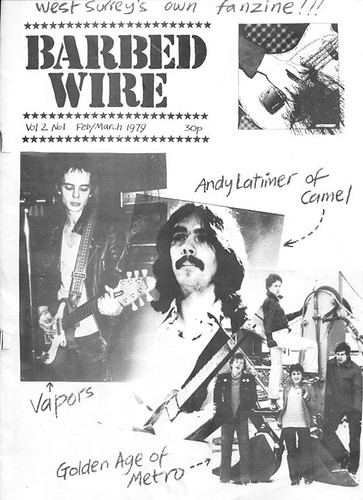
The second issue (Vol 2 No 1) came out Feb/March 1979 and was printed in an architects' office (SBT) after hours by Sharon Whittaker, who also shared Nick's flat where I was living, and her boss Mrs Hook: I pasted up the typewritten text onto boards using Cow gum and put squares of black paper where the photos would be - any other embellishments were drawn in ink directly onto the camera-ready copy. In return I was given the pages as negative film and stripped the half-tones into the clear holes made by black squares of paper using sellotape. The printed sheets were later folded with the back of a spoon, collated and stapled by mostly me on the floor of my flat on York Road. On the cover were The Vapors, Andy Latimer of Camel and the Golden Age of Metro. I remember first seeing the Vapors at the Royal after abandoning a gig at the Wooden Bridge. It was love at first hearing: Alan 'Bed and Breakfast Man' Neve was dancing at the front and they just blew me away - I've been a big fan ever since. Gus had the main feature - on Camel, Virginia wrote about Metro, centre spread was on Rubber Flowers by NW (?) and there was a review of Brighton classic album Vaultage 78 by Ellen Jones. And Sev got his own column.

Barbed Wire ran to six issues, the last one in May/June 1980. It never sold well - most got nicked - and we were eternally grateful to Rough Trade for taking 50 copies cash in hand, and we sold the odd ad to record shops, barbers and sound studios. One great spin-off was getting into gigs for free on the guest list - and free records, tho they generally got kept by the reviewers. More later...

bw2.jpg


More photos on Flickr.

Edinburgh festival 2010


Astronaut
Originally uploaded by fred pipes
People say to me: never mind all this nostalgia nonsense, what we want to know is what did you get up to at Edinburgh? Well, the usual really: Stewart Lee (twice, in two different shows but with similar material - one at the Festival Theatre with Franz Ferdinand and Frank Chickens and the other a Gaza benefit with Daniel Kitson and others), the dependable Simon Munnery (but no AGM this year, and the show didn't appear to be about self-employment as advertised), David O'Doherty (some great jokes about cycle maintenance) and a whole raft of shows starring Brighton people: Tim Crouch's 'The Author' at the Traverse, Mim's 'Dinner for one', Nick Pynn, Beach Hut Mutts, Mr B the Gentleman Rhymer - plus some shows recommended by my infallible guides Peter and Lisa (who'd been up earlier in the month), notably the excellent Poland 3, Iran 2. We also celebrated Foz's birthday, and I went to see Brighton author Marek Kohn gave a talk at the Book Festival on his climate change book 'Turned out nice'

I didn't think the art was up to much (mind you I probably missed some crackers). Sam and I tried to get to the Modern Art Gallery and the Dean (showing surrealist art from their permanent collections) but no buses seem to go there any more (bring back the Art Bus!) and we ended up in Cramond, which was nice! Martin Creed at the Fruitmarket was OKish, esp the musical stairs and lift, but systems art - putting objects in order - can get a bit tedious quite quickly. My favourite exhibition was at the good old Forest Fringe, in the TotalKunst room: Mik Godley's iPod drawings of Nazi flying saucers, done using various apps: Brushes, Sketchbook Mobile and Paintbook 3 Vector. And next door, wannabe astronaut James Baker was attempting to get into space by climbing a stepladder in 30 Days to Space. By climbing a 6ft ladder 1467 times each day for 30 continuous days he hoped eventually reach a height of 50 miles - space. Each climb of the 6ft ladder was marked by drawing a chalk star onto the wall. Hope he made it!

Otherwise it was just lots of good food and great beer in fabulous pubs. Chance encounters on the Royal Mile with heavy metal ukulele players and balloon-blowing clowns, watching The Illusionist in the actual cinema featured in the film, oh and being roped in as judges at Tricity Vogue's Ukelele (that's how she likes to spell it!) Cabaret! In fact, another great week away at the Edinburgh Festival.

Nazi flying saucers

More photos on Flickr.

23.9.10

Poppa Ben Hook

Googling Poppa Ben Hook, the Guildford Arts Lab's house band, came up with this link to bassist Phil Plant, who is still working - with Roxi and the Blue Cats.

22.9.10

Glad Day... and Guildford Arts Lab

[This recollection was first published on my Geocities website in 2006 - but as the future of Geocities is uncertain, I thought I'd re-publish it here with a few tiny amendments.]

Cover of Glad Day 1 hand drawn by Yours Truly
Glad Day was a spin-off from Guildford Arts Lab (1965-1971). It was an A5-size poetry and image mag that ran to just two issues. First issue was published in 1973 and was described as being 'holographic', ie all drawn and lettered by hand (or from the authors' typewriters). The 'Valuable first issue' cost 25p and was printed offset by Bob at Guildford Print. It was 44 pages long and included contributions from Fred Pipes, Gus Garside, Graham Clarke, Clive Young, Keith Bradley, Martin Jones and Philip Crick. Cover illo by Fred Pipes depicted 'Janina (Candy Darling) Lech looking out over the old Guildford on Glad Day eve'. The name Glad Day is taken from the title of a William Blake poem.

Contents page of Glad Day 1 hand drawn by me
Glad Day 2, with cover drawn by Wal

Glad Day 2 was 40 pages long and came out in 1975, funded by South East Arts Association. This time, much of it was typeset. The cover was by Fletcher (Wal) Wallis and it included contributions from Michael Horovitz (with his poem Glad Day), Graham Clarke, Fred Pipes ('French nudes'), photos by Wal, Guido Casale, Saul Martin, Neil Richardson, Martin Jones and Janina Lech, who illustrated 'Back to the Front' a series of poems by Gus Garside. It was printed Up North at Salford University Union by Neil Richardson (my old school friend who sadly died recently). There is much more about Guildford Arts Lab on my Shyneford website, including a list of gigs and events, many photos and much ephemera. Its main publication was Whole News, a Roneoscan production usually running for just 2 or 4 pages printed by Robin Bradbeer at the University of Surrey Union. Very few of these survive! On the fifth anniversary of the Arts Lab in 1970, we produced a book called Five Whole Years.

Contents page from Glad Day 2, top and bottom drawn by me with my best Rapidograph

Other reminiscences:
Prologue
British Blues: part 1 Bury
British Blues: part 2 Manchester
British Blues: part 3 London
Helix

Helix: my time as a rock star

[This recollection was first published on my Geocities website in 2006 - but as the future of Geocities is uncertain, I thought I'd re-publish it here with a few tiny amendments.]


I did promise, on my British Blues page, a history of Helix, the poetry and jazz band (don't laugh!), starring Yours Truly on harmonica and poems, Rick Welton, also on poems, Chris Brunt on flute, alto sax, clarinet and guitar, Peter Panayi on bass (there's a recent picture of him in the News section of www.brookguitars.com), Peter Jackson on guitar and Terry Raven on drums. I was off to a Physics Dept reunion at the University of Surrey, and rooting through some ephemera, when I found a cutting of an ad in NME (or was it Melody Maker?) showing us supporting Joe Cocker on 24 January 1969, our greatest achievement!


It all started in the folk club at UoS (then Battersea College of Advanced Technology) where me and Chris did a double act: he (Blind Willie Brunt?) on guitar and me (Whistlin' Walshaw Fred) on harmonica, singing the blues. Also playing regularly were duo Pete Panayi and Ronnie Hicks (wife of Rick Welton). Eventually we all got together to perform Dylan songs with Ronnie as vocalist. Rick was the roadie (he had a van) but started adding his poetry to the mix. Then Ronnie left and we decided to go electric. An ad in NME (or was it Melody Maker?) produced Peter Jackson, who'd been playing the US bases in Germany, and part-time Horror film actor Terry Raven. By now we were doing poems (me funny, Rick serious) and the odd Mose Allison song (plus 'Scarborough Fair' I think!). There is one recording, made at All Saints Hall in Powis Square, Notting Hill, recorded by Ronnie's new bloke, film sound man Tony Jackson, but we never made any records.


We were represented by Pete Jenner of the Blackhill agency (who managed Pink Floyd before Syd left, and went on to organise the Hyde Park free concerts) - Lynne, a booker there was married to my friend Adrian Boot, who went on to photograph Bob Marley and others. Their offices in Notting Hill later also became home to Stiff Records. We did gigs at Canterbury (supporting Third Ear Band), Bradford (with Liverpool Scene), Chelsea Town Hall, Bridgend in south Wales, in Battersea's Courland Grove halls of residence where I met an American girl called Clare Greenwood, and in Guildford, at the Stoke Hotel (22 December 1968) where I met Jenny Parsons and was introduced to Guildford Arts Lab. 


Two notable concerts were the Jazz Poetry Song Package at Battersea Town Hall on 28 November 1968 and Guildford Civic Hall on 8 December, both with the Michael Garrick Quintet featuring Don Rendell and Ian Carr with various poets, including Jeremy Robson and Vernon Scannell, with Ron Geesin and Pete Brown (of Cream lyrics fame) and his Battered Ornaments (inc Chris Spedding and Dick Heckstall-Smith).

All done in Letraset by Rick!

The Stoke Hotel gig may have been our last. Rick moved to Guildford to run the first Guildford Festival (he's now a LibDem councillor in Hull), and I followed some time later. Chris teamed up with Ronnie and Eric Johns (brother of Dorris Henderson) to form Gallerie, who played with Roy Harper and Michael Chapman in the 1971 Guildford Festival, the one I directed. By now I was reading poetry with the Arts Lab and about to get married. To be continued dot dot dot

Page from the programme of Jazz Poetry Song Package (price 2 shillings) 
Other reminiscences:
Prologue
British Blues: part 1 Bury
British Blues: part 2 Manchester
British Blues: part 3 London

Glad Day and Guildford Arts Lab

Jump to the post-1969 Arts Lab years of Shyneford >>

16.9.10

British blues: part 3 London

[This recollection was first published on my Geocities website in 2006 - but as the future of Geocities is uncertain, I thought I'd re-publish it here with a few tiny amendments.]

In September/October 1965 I went to the Battersea College of Advanced Technology/University of Surrey (designate) and met Steve Whitehead (he lived on the floor below at Ralph West Hall) who also liked blues. (Steve just reminded me by email of a series on Granada TV which featured an amazing roster of US blues musicians playing around derelict railway stations in the Manchester area.)

One of the reasons I wanted to go to London was because I'd read about the Flamingo and Marquee clubs in NME and wanted to be part of that scene. I saw Jesse 'Lone Cat' Fuller at the 100 Club (17 October 1965) and got his autograph.


On my course was Chris Brunt, who played alto sax, clarinet, flute and guitar! After a term in hall I moved into his flat in Hammersmith. We played blues at the folk club – he on guitar, me on harmonica (under the name of Whistlin' Walshaw Fred – the Fred had came from Freddy and the Dreamers who I was thought to resemble!) – and this formed the beginnings of Helix.
Valid until 31st March 1966
I was also a member of the stage lighting crew, which got me into gigs free and backstage. Battersea alternated Saturday 'dances' with Chelsea College over the river - us one week, them the next. We also decorated the hall with huge sheets of paper painted up with various scenes. This was just before light shows took over. After our painting we'd adjourn to the Green Cafe on Battersea Park Road for a slap-up lunch. I saw The Animals, Steam Packet with Long John Baldry and Rod Stewart, and many other bands, including (I'm sure) one of the first gigs by Led Zeppelin possibly under the name of The New Yardbirds, and on Saturday 1 October 1966 (just looked through my diaries) the Bonzo Dog Doo Dah Band, supported by Dave (David?) Anthony's Moods.

Suki
I'd been playing blues harp since school, and Suki (Shelagh Reece) had even made a coffin-shaped box for my Echo Super Vamper in A. Some memories of my band Helix are published elsewhere.


On Sunday 5 December 1965 I saw my hero Jimmy Smith at the New Victoria ( a double bill with Dizzy Gillespie!). I had a much better view of him when he played the Brighton Concorde a few years ago. I was on the front row, and when I asked for his autograph in the interval, he kissed my head!


I also saw Thelonius Monk at the Fairfield Hall, Croydon, 25 April 1966, with Chris Brunt. By this time I was getting into jazz and buying Charlie Parker records.

There was a second wave of Brit Blues in Fleetwood Mac, Chicken Shack and Duster Bennett, but they were already being mocked by the likes of the Bonzo Dog Doo-Dah Band (one of my all-time favourite bands) with 'Can blue men sing the whites' from The Doughnut In Granny's Greenhouse (1968) and 'I've got those Fleetwood Mac, Chicken Shack, John Mayall, can't fail Blues' by The Liverpool Scene from Bread on the night (1969). The mods were growing their hair and becoming hippies and the blues was turning into prog rock and heavy metal.

Other reminiscences:
Prologue
British Blues: part 1 Bury
British Blues: part 2 Manchester

Helix
Glad Day and Guildford Arts Lab

British blues: part 2 Manchester

[This recollection was first published on my Geocities website in 2006 - but as the future of Geocities is uncertain, I thought I'd re-publish it here with a few tiny amendments.]

By this time I was in the sixth form at school and every Saturday night I was getting on the electric train from Bolton Street station to Manchester Victoria (now part of the Metro tram network) and going to the all-nighters at the Twisted Wheel and Oasis clubs, as well as the Cavern, Heaven and Hell (which had just ultra-violet lights downstairs in hell so all you could see was dandruff and bra straps!),

Expires 31st December 1964
the CubiKlub in Rochdale, the Boneyard in Bolton,

Expires 16 July 1965
and the Manchester Sports Guild for trad jazz.

I don't live there any more! 

Other cool cats (soon to become Mods) included Roy Henshall, Bob Stoney, Suki, Steph Minta, John Dickinson and Pete Entwistle.

'Wade in the water' – the B-side of 'Tammy', by the Graham Bond Organisation
This was before Northern Soul and clubs like the Twisted Wheel played an eclectic mix of music - Tamla and Stax soul (obviously), but also British beat, jazz (Jimmy Smith mainly), folk (Dylan) and blues (Jesse Fuller's 'San Francisco Bay Blues' was very popular). It's easy to forget but these clubs weren't licenced – there was only frothy coffee on sale, and we kept going with purple hearts, black bombers and dexies (all forms of speed I believe) along with the odd ten-bob deal of shit (draw). I was also going to Bury Palais to watch the Beat groups – saw them all, except The Beatles! All of the beat groups covered blues classics – even Blackburn band The Four Pennies had a hit with a Leadbelly tune – 'Black girl'. Then of course there was Manchester's own Victor Brox Blues Train, him with the pocket cornet or whatever it was! Most authentic in my opinion was Manfred Mann. Roy was buying Chuck Berry and Bo Diddley LPs by this time.


I saw the Graham Bond Organisation at the Oasis, and got all their autographs. It was Dick Heckstall-Smith on tenor sax, 'Europe's top drummer' Ginger Baker on drums and Jack Bruce on bass. We were queuing when he was struggling down the steps with his Hammond organ and he quipped that he should have taken up the mouth organ! He was awesome, and a great alto saxophonist too. I bought his single Tammy – for the B-side 'Wade in the water' and one of my favourite albums of all time is the 1964 Decca LP 'R&B' which also showcases Alexis Korner (with a sublime track 'Night time is the right time' featuring Ronnie Jones singing and Bond on sax), Zoot Money, John Mayall, and (the weakest) Dave Berry.


One of the greatest compilations of all time, not available on CD although many of the original tracks are on Decca mod and 'scene' compilations. Graham Bond's 'Hootchie Coochie Man' here is a much better version than on his Sound of 65 album.

1. Hi-heel sneakers - Graham Bond Organisation - R&B
2. Not fade away - Dave Berry - R&B
3. Early In The Morning - Alexis Korner - The Blues Scene
4. Walking The Dog - Zoot Money's Big Roll Band - The Mod Scene
5. Mr James - John Mayall and the Blues breakers - R&B
6. Long Legged Baby - Graham Bond Organisation - The Mod Scene Vol. 2
7. You better move on - Dave Berry - R&B
8. Diddley Daddy - Dave Berry - R&B
9. Hootchie Coochie Man - Graham Bond Organization - R&B
10. Get On The Right Track Baby - Zoot Money - The Blues Scene
11. Little Girl - Graham Bond Organisation - The Mod Scene
12. Crawling Up A Hill - John Mayall - The R&B Scene
13. Strut Around - Graham Bond Organisation - The Blues Scene
14. Night Time Is The Right Time - Alexis Korner (Ronnie Jones, vocal) - The Blues Scene

Another milestone album was Golden Guinea's 'Rhythm and Blues' with a mixture of black US bluesmen – Sonny Boy Williamson, Muddy Waters, John Lee Hooker and others.


At the Twisted Wheel I saw Sonny Boy Williamson (in his 'jester' suit), John Lee Hooker, Howling Wolf, Spencer Davis Group with Steve Winwood and many many others - one day I'll look up the Manchester Evening News archives to see who else was on in 1964-65! I also went to the Free Trade Hall on 29 September 1966 to see the American Folk Blues Festival '66, with Pete (Pedro) Entwistle, starring Sleepy John Estes and Yank Rachell, Junior Wells, Otis Rush, Roosevelt Sykes 'The Honeydipper' and Big Joe Turner.


Other reminiscences:
Prologue
British Blues: part 1 Bury

British Blues: part 3 London
Helix
Glad Day and Guildford Arts Lab

Can blue men sing the whites? Part 1 Bury

[This recollection was first published on my Geocities website in 2006 - but as the future of Geocities is uncertain, I thought I'd re-publish it here with a few tiny amendments.]

Every harmonica player wanted to play 'Country line special' like Cyril! Recorded 1963; Cyril died in 1964

I just watched Mike Figgis's contribution Red, white and blues (what on earth were Tom Jones and Lulu doing in there?) to Martin Scorsese's The Blues and thought I'd add my recollections to the debate.

I was born and brought up in the northern town of Bury, Lancs (now part of Greater Manchester). My earliest memories of pop music were hearing The Shadows play Apache on a tannoy at Tranmere Rovers football ground (Bury beat them 7-1!), and Del Shannon, Dion and Johnny and the Hurricanes while watching the girls on the waltzers at Bury fair. My dad played double bass in a dance band at Alma Lodge and had a few jazz records‚ light stuff mainly, like Oscar Peterson. He got talked into playing with a rock'n'roll singer once (I went to a rehearsal) but he thought it was rubbish and never went again. My first LP was a 10-inch 'The Duke wore jeans' by Tommy Steel; my first single was Tom Dooley by The Kingston Trio (not the Lonnie Donegan cover!). The first concert I attended was Adam Faith at the Royal cinema (14 November 1960). It was more like a variety show, with the John Barry Seven and other acts.
Found this poster on the Bury Olden Days
Facebook page
Me and my friend Roy Henshall used to listen to Radio Luxemburg – he'd tape all the distant sounds on his reel-to-reel. I remember hearing 'Love me do' for the first time and thought Wow! this band will go far! We eventually formed a band, with Michael Brawn on drum (yes, he only had a snare!), called The Roadsweepers. Later Roy learnt some chords and ended up with Billy J Kramer and the Dakotas (after they were famous). He's now living in Tenerife.

I also bought Volume 2. These were recorded in 1962 and featured Alexis Korner on guitar and Keith Scott on piano
There weren't any blues records to buy in Bury. I read a rave review of Alexis Korner's R&B from the Marquee (1962) and ordered it from Boots on the Rock ( I later lent it to John 'Faff' White in Guildford and never got it back!). In other record shops I also found a couple of EPs with Alexis Korner on guitar called 'Chris Barber presents Jimmy Cotton' in the jazz section, and an LP called 'Murderers' Home' on Golden Guinea – recordings of prisoners' work songs by Alan Lomax.

'Early in the morning' was covered by Alexis Korner and Graham Bond amongst others 
Eventually I found the classic blues EP 'The sound of Cyril Davies' with the amazing 'Country line special' – there's no line-up listed on the sleeve. I bought Alexis Korner's Blues Incorporated at the Cavern and also found an old Alexis Korner Skiffle Group EP in a bargain bin, called Blues From The Roundhouse Volume 1 (I found out later that there was also a volume 2!) also starring Cyril Davies.

Recorded 1957 and featuring Cyril Davies on 12-string guitar and harmonica and Mike Collins on washboard!

Other reminiscences:
Prologue
British Blues: part 2 Manchester
British Blues: part 3 London
Helix
Glad Day and Guildford Arts Lab

15.9.10

I'm from Bury


me-and-benji72.jpg
Originally uploaded by fred pipes
...sings Mark E Smith, even though he's from Prestwich, closer to Manchester. I'm from Bury, Lancs - or now Greater Manchester - in the North of England. I was born two years after World War II ended in a maternity hospital in a district called Jericho and lived for my first three years in Wyndham Street, in an area of central Bury called The Mosses. After that we went up in the world and moved nearer Whitefield (and Prestwich) to an estate of semis called Sunny Bank, when it was just three or four streets off Manchester Road, surrounded by fields. The fields were being built on - so lots of places to play, including lime pits - and today it's a huge sprawling suburb, a mainly Jewish overspill from North Manchester. Dad, being a travelling salesman for a paper-machinery company, had the only car, well, a green Commer van actually, in the street for many years. We weren't the first to get a television, however.

The Mosses was demolished and lay empty for years, the grid of streets still visible, hosting the annual fair, with its black pea stalls, nude show, steam yachts, big wheel and waltzers, which as kids were our discos, playing all the hits - Johnny and the Hurricanes, Del Shannon and Lord Rockingham's XI - at full volume, trying to mask out the noise of the huge throbbing generators ringing the fair's edges. Today it's buried under the 'world-famous' market and Angouleme Way (named after Bury's twin town in France).

School was a long walk away back in the direction of Bury: St Chad's near Gigg Lane, home of Bury FC 'The Shakers', and then after my 11+ Bury High School, which became The Derby School, and is now a sixth-form college. I failed to pass the entrance exam into Bury Grammar School so never met Victoria Wood! The other place to hear pop music was at football matches and I can remember first hearing The Shadows' Apache at Tranmere Rovers' ground, when Bury thrashed them 7-1 (on 1 October 1960).

Another place I lived for about a year 1961-62 was The Robert Jones & Agnes Hunt Hospital in Oswestry, Salop, where I was 'cured' of a congenital defect - well, they tried their best. Treatment for the condition is much more successful nowadays. Soon after returning home, we moved to the other side of Bury, off Bolton Road, to a dormer bungalow. It was still a long walk to school! My sister and her children all live nearby to this day. In 1965 I travelled south, to London (along with pop star Peter Skellern), a place Down South I'd read about in Melody Maker, the NME and Sounds - where it was all happening.

The reason I'm writing this is to preface some reminiscences that I'm going to move over from my Geocities site to this blog, as Geocities will be closed down at some point.

Other reminiscences:
British Blues: part 1 Bury
British Blues: part 2 Manchester
British Blues: part 3 London
Helix
Glad Day and Guildford Arts Lab

26.8.10

Plans to demolish Astoria in Brighton

Plans to demolish Astoria in Brighton (From The Argus): Oh no! what will happen to my murals?? We can't let this happen...

L'illusionniste at the Cameo


Cameo cinema
Originally uploaded by fred pipes
There's a scene in Sylvain Chomet's beathtakingly beautiful L'illusionniste (The Illusionist) in which the Jacques Tati character stumbles into the Cameo cinema, in which Mon Oncle is playing (there's also a poster for Belleville Rendez-vous outside!). We see the interior with a few rows of seats dotted here and there with people, and its classical columns and arches either side. And I'm watching the film in that very same cinema - how cool is that?

An animated cartoon film about a conjurer? That's about as daft as putting a ventriloquist on radio - but it works, the tricks are just as beguiling! It's also about the death of variety, which is pretty ironic as here we are 50 years later and all around all manner of live acts are entertaining the punters in the Edinburgh Festival Fringe. Some people have said the film is slow moving, but the pace is about what you'd expect in a Tati film - it's based on an unpublished script of his, written in 1956. Its glory is in the gorgeous drawing and attention to detail - from the awesome panoramas of the Western Isles (it has to be seen on the big screen) and the aerial tracking shots of 1959 Edinburgh to the chip shop menu, the cars and buses and the many steam trains (I spotted 4472 Flying Scotsman near the end and the others depicted looked spot on). The sound effects are also remarkable. Wet and hilly Edinburgh has never looked so beautiful. If you do go, take some tissues - it's ultimately a sad and moving story - and don't leave before the credits have rolled - there's a bonus bit at the end!

3.8.10

Westward Ho! to Wales


Worm's Head Ale
Originally uploaded by fred pipes
Continuing my exploration of Britain's extremities, I left Bristol on Monday 26 July and crossed the border under the tunnel into Wales. The objective was the smallest city in the world - St David's, a name that often appears on BBC weather maps. But first I had to visit that mini-extremity the Gower Peninsular, a district made famous by map-drawer Neil Gower (I wish I could find that postcard he drew!). I headed for Swansea, Freedom of South of Wales Flexi-Rover in my hand (but see my rant about it), and stopped off at Swansea Market for some laverbread and cockles to sustain me. Hmm, I love seaweed but the small 'teb' at £2 was far too much for me. The-hot-off-the-griddle Welsh cakes however were yummy. I only had time to pop my head into the famous Kardomah cafe, before catching the 118 bus to Rhossili. The bus journey wasn't as scenic as I'd hoped, with just tantalising glimpses of far-off bays through hedges, and it didn't go to Port Eynon either. When we arrived at the extremity, my heart sank, seeing a long long walk downhill ahead of me (and the corresponding long walk uphill back). However, an unprepossessing pub beckoned and with a pint of Tomos Watkin's Worm's Head Ale in my hand I went out into the beer garden at the back to be presented with the most amazing sight! Bar Helvetia (named after the 1887 wreck on the beach) of the Worm's Head Hotel must have one of the world's most outstanding views.

After an unsuccessful trip to find the Mumbles and a night at the excellent Alexander Hotel in Uplands (£35 a night), I set out west again (a train ride with wonderful views of the coastline) to the ancient city of Carmarthen, my base camp for St David's. But first, to get my steam railway fix, I made a bus detour to Bronwydd Arms - no not a pub, but the station for the Gwili Steam railway. As I puffed down the 1/4 mile hill from the bus stop, the train was just about to leave, but a chap in a hi-vis very kindly made it wait until I'd bought my ticket (£4 with senior and Rover discounts). The train was in two halves: the front were all having an optional cream tea; the rest were in the back two carriages. At the end of the line at Danycoed I discovered we were being hauled by Haulwen, a Vulcan Foundry 0-6-0ST, and there were several other industrial locos dotted about in various states of repair. After an apple slice in the cafe and a tour of the signal box, I headed back to the smart Spilman Hotel (£54 a night).

Wednesday 28 July was St David's day, so I got a train to Haverfordwest (which had another castle and looked like a nice place to visit) and the 411 bus to St David's. After a near miss head-on with a white van on the narrow roads and some spectacular views at Newgale, we arrived at the village. I was expecting a mini-cathedral like the one in Kirkwall, Orkney, but just down a lane, in a dip was the full-size deal! Plus a ruined Bishop's Palace behind. I had a very nice bowl of tomato and basil soup in the refectory and a walk round - the misericords and roof caught my eye. The real extremity on the coast looked like a long walk away, so as I had a while to wait for the bus back, had a pint in the only pub in the city, The Bishop's.

Thursday I was heading back to Swansea to stay with my friend from late-1960s Guildford, Loppy, but for a bonus trip decided to head to Tenby, a place I'd seen on the tv programme Coast, and the most popular place in the whole of Wales, judging by how ramjam packed with kids the two-carriage diesel was! At Tenby I discovered a cafe with a fabulous view, appropriately called Caffe Vista, had a quick whizz round the town and back onto the train for Swansea and a coffee with Loppy and her friend Julie in The Mumbles. And Friday it was the long journey home, changing at Cardiff and Bristol. Job done! Some great views and a steam train.

Other extremities:

John O'Groats and Orkney

Margate and Ramsgate

Dungerness

PS. Obviously, I didn't set out from Westward Ho! This Devonshire village has the only place name in the UK with an exclamation mark. Unfortunately, the Transport font, designed by Jock Kinneir and Margaret Calvert between 1957 and 1963, used for all UK road signs, doesn't have an exclamation mark!

2.8.10

Bristol: Thekla and Brunel


The real Mr Brunel
Originally uploaded by fred pipes
When I was thinking of relocating from Guildford back in 1987, Bristol was on the list. It's arty, what with the Watershed and Arnolfini, near water and has that industrial chic. Brighton won out, however, but I was back in Bristol on Saturday 24 July to see a performance of Viv Stanshall's Stinkfoot at the Thekla, the ship he called 'The Old Profanity Showboat', where it was first performed in 1985. I knew nothing about Stinkfoot or what to expect, so in a moment of madness booked two nights at the YHA, based on price and its fabulous location right on the dockside. The downside was that I had to bunk up with snoring strangers and brave its ferocious showers!

Originally co-written with his wife Pamela Ki Longfellow and based on a children's book she'd written, this production was more of a promenade showcase, with songs belted out by many of the original performers (including Nikki 'B' Lamborn, Jon Beedell, and Pete Coggins), narrated splendidly by a stubbly Tony Slatterly, with Pete Moss conducting an amazing band squashed into the right hand of the stage and auditorium, and Viv and Ki's daughter Silky Longfellow-Stanshall taking centre stage as Elma the Electrifying Elver. Cats it wasn't, but I must confess that in the first half it was sounding like Meatloaf meets Tina Turner (or Janis Joplin?), what with all the big voices, but it got better in the second half, the highlight of which was the appearance of Viv's ukulele! To my shame, the only songs I recognised were the lament 'I'd rather cut my hands' and the show-stopper 'No time like the future' but we joined in where we could - others had a Brechtian/ Tiger Lillies / Nigel Burch / Foster & Gilvan feel to them - must investigate them further (listening to 'Dog Howl in Tune' now). See some of Mark Garland's photos of the show here.

So, Stinkfoot over and a sleepless night in a top bunk, it was Sunday 25 July and time to explore Brunel's Bristol. After a pleasant walk by the 'floating harbour' (shame the steam harbour railway wasn't operating), I was first visitor into SS Great Britain. This attraction must get a prize for best ticket (and for the £9.50 you can revisit for a year) and the ship itself is fabulous! First you get to go 'underwater' to visit the hot dry dock in which it was built, with a close up view of the revolutionary propeller and balanced rudder - and all the holes in the iron hull!) then through an exhibition (where you get the opportunity to stamp your ticket!) and finally onto the weather deck (curiously low and flat, compared with modern day cruise liners!) - and then below! There's a lot to see, from the cramped berths, even in 1st Class, to the steam engine, only ever meant to spring into action when the wind dropped, the promenade deck full of light and where they stabled the horses in the bow. As I was leaving, I chanced upon Mr Brunel himself strolling about and took a photo. As I left, a huge queue was getting longer, so get there early!

I took the 60p ferry across the water and met my IllustratorsUK friend June Goulding, for a soup in the Museum and Art Gallery and a bus trip to Clifton to see Brunel's Suspension Bridge. Now, I have a bit of a phobia about bridges, and this is a bit of a tall one! We joined the 3pm tour, but soon got bored and decided to go it alone. Phew! Don't look down! Well, I made it across, and after a visit to the shop, we came back along the opposite side, with a view of the Giant's cave where Brunel's original scheme would have terminated and the sight of a couple of brave chaps clambering up the cliffs on ropes. Then it was back to the YHA to grab a better bed, a pint at the Llandoger Trow (I preferred the Bath Ale at the YHA to be honest), and - tired and aching - to bed before heading off to South Wales the following morning.

PS. At breakfast at the YHA, I made a piece of toast and presented it on a plate to the counter assistant, asking for baked beans and scrambled egg to be placed on top. She arranged the cooked food neatly around the toast! This revelation started quite an interesting thread on Facebook, some people asserting that beans would make the toast soggy. I say that's the whole point! The clue is in the name: beans on toast.

PPS. Another treat was to see 71000 Duke of Gloucester in the sidings just outside Bristol, ready to haul the Torbay Express.

31.7.10

A rant about Rail Rovers

A Rail Rover is a great idea - in theory - you get 4 out of 8 days unlimited travel by train and some of them even include ferries and buses, especially important in Scotland and Wales where English bus passes are not recognised. So, for my latest trip around South Wales I wanted to buy a Freedom of South Wales Flexi Rover. That's £54 (or £35 with senior railcard) for four days train and eight days bus travel. So far, so good. However I then discovered that you can't buy one online, the man at the end of the Arriva phone line had never heard of them ('Did I want a season ticket?', he asked) and Brighton ticket office said I could only buy one 3 days in advance. So on my day of travel, I popped into the Travel Centre at Brighton station and bought one (I'd already bought my tickets to Bristol and back from the Great Western website). Trouble was, when I first tried to use it, I was informed by the guard that I'd been given in fact a 3 in 7 Rover! Not good at all... I'd neglected to print off the list of buses I could use and a map of the rail lines covered, so at Swansea I popped into their Travel Centre and got my 'pack', with map, vouchers and the all-important list of bus companies participating. This was to become very useful. The assistant was bemused by the 3 in 7 bit, as these don't really exist, but couldn't exchange my ticket for a proper one - I would have had to buy another Rover and try to get my money back at Brighton. But as I'd already used a day's worth (the guard had kindly filled in the first box - of four! - for me!) I decided to risk it and maybe forget to cross off one or two of the days. My first encounter with a bus was my trip to the Gower. The driver scratched his chin insisted they didn't take them and I had to stump up £4 for a Gower Explorer day ticket! That bus company was on the list, and after that experience I underlined the bus companies I was attempting to get journeys out of in the pack brochure and stuck it under their noses! Granted, it got easier the further west I travelled, but it was embarrassing to be viewed with suspicion every time I wanted to make a bus journey. I put it down to the design of the pass. First, it's flimsy for something that will be in constant use for 8 days, plus it says Rail Rover in big letters at the top - nothing about buses! On my travels I spotted loads of posters on stations for the 'Freedom' pass, but nobody had informed the bus drivers about it! Why not a more substantial pas, with Rail and Bus Rover in big letters and a list of the bus companies covered on the back. But maybe that's what they should look like and Brighton sold me a dud! Next time, I'll wait to buy my Rover in the area I'll be needing it in - or online if they'll let me - like last year's Scottish Rover. PS. And why can't they print the Rovers on card that you can actually write on without it smudging?

6.7.10

Top 5 Isle of Wight attractions


Shanklin cliff lift
Originally uploaded by fred pipes
The Isle of Wight is a bus pass paradise. Almost all the bus routes radiate out from Newport, in the middle of the island, and all buses go to the seaside. Get yourself a Southern Vectis timetable and the isle is your oyster! It also includes useful town centre maps. There are one or two complications however: some routes, such as the 7 to Alum Bay, go three different ways (why not call them 7a, 7b and 7c I wonder?) so check the small print. Another swizz is that some destinations, such as the Needles Batteries and Shanklin Esplanade, are only accessible by Breezer buses, and they cost a tenner for a day ticket (but you do get an open-top ride and an informative running commentary). We were staying in a lovely thatched cottage in Carisbrooke (on all the 7 route variants), close to Newport, so were ideally placed to explore the island. Here are my top five attractions.

1 Isle of Wight steam railway
The steam railway is a fragment of what was once an extensive rail network, now mostly cycle paths. It goes from nowhere (Smallbrook Junction, where it meets the Island Line, the official railway from Ryde Pier to Shanklin which uses old London tube trains, but no other way off the platform) to the middle of nowhere (near Wootton, but thankfully near a 9 bus stop). The main station, Havenstreet, is where the shop, shed, cafe and museum is. The locos are mainly industrial Hunslet saddle tanks, thought they have a couple of Terriers and there's a strange 'O2' Class 0-4-4T No W24 Calbourne being restored and almost ready for action. There's also a workshop where some amazing carpentry is going on.

2 Needles Old Battery
Every visitor to the Isle wants to see the Needles, and the best place is from the Old Battery, right at the western tip of the island. The bus only goes to Alum Bay, so it's either a long walk along the cliff top or a hair-raising ride on the Breezer. Cars can only go as far as the £4 Alum Bay car park. It costs to go in, but the view from the searchlight tunnel is well worth it. And there are explanatory cartoons everywhere by Eagle and Lion artist Geoff Campion. The New Battery (closed on Mondays) is further up the hill and is where secret rocket tests were held.

3 Cowes chain ferry
I love ferries, and this one is similar to the chain one at Poole Harbour. It also reminded me of the ferry between North Shields and South Shields. I went from East Cowes to Cowes (there is no West Cowes!) and it's free for pedestrians and cyclists. Unfortunately, unlike Poole, you can't get the bus over it! There is nothing to see at East Cowes (except Osborne House) and Cowes reminded me a bit of Falmouth or Hastings old town, with its pedestrianised high street, running parallel to the sea. Couldn't find a pub with a sea view!

4 Carisbrooke Castle
This is one big castle, bang in the middle of the island. Our cottage was at the bottom of the hill, by a ford, and used to be a tea rooms catering to the tourists who arrived by train. There is no station now, so most people arrive by coach (no bus goes up the hill!). It houses a museum, with cases on local legends Robert Hooke (born in Freshwater), Tennyson and the pioneer seismologist John Milne. The biggest claim to fame is that it was prison to Charles I and his two youngest kids. It also has a donkey-powered treadmill well.

5 Shanklin cliff lift
This took some finding. When I first went to Shanklin I had no idea where to find the sea! So I headed for tourist information and got some directions to the Lift. It's not signposted or easy to find, though it's visible from Sandown! The Victorian lift, build 1891, must have been a great thrill to travel in, with its windows and huge drop, but the 1960s version is just a concrete tower with a bog-standard office block lift built in. The original cost 1d down; 2d up - the modern one was a pound return. The esplanade down below - and pubs such as the Steamer inn - isn't accessible by regular bus, but a Breezer does go there. Another way down is via Shanklin Chine, lit up at night.

Steephill Cove

Other attractions include:
Steephill Cove, and crab sandwiches
Brading Roman Villa, with its mosaic of a chicken-headed man
Osborne House, home of Victoria and Albert
Model village at Godshill
Alum Bay chair lift
Boat trip around the Needles from Yarmouth

Other visits to the Isle of Wight:
April 2009
April 2008

Other blogs:
Roundhill Rob was another holidaymaker staying at our cottage
The Lost Promenade visited Shanklin and Sandown

More photos on Flickr.